
Views: 0 Author: Site Editor Publish Time: 2026-05-16 Origin: Site


A marble dining table is a statement piece. It commands attention and anchors your room beautifully. Yet, the reality of daily use often clashes heavily with this pure aesthetic appeal. Spills, scratches, and heat can quickly damage delicate surfaces.
Buyers face a challenging decision today. You must weigh the timeless, organic beauty of a natural marble table against the rigorous maintenance it constantly demands. Alternatively, you might opt for engineered options. These modern alternatives promise exceptional durability but vary wildly in overall quality.
This comprehensive guide breaks down the essential physical properties, maintenance realities, and cost-to-lifespan ratios of natural versus faux materials. We strip away the marketing jargon to present clear, factual comparisons. You will discover exactly how these surfaces handle everyday life. Ultimately, we provide this evaluation so you can make an evidence-based investment for your dining space.
Natural marble offers undeniable luxury and unique veining but is a porous, high-maintenance material (Mohs hardness 3-4) prone to acidic etching and staining.
Faux marble spans from budget resin/acrylics to high-end sintered stone—the latter offering zero porosity, extreme heat resistance, and a Mohs hardness of 6-7.
Natural stone requires bi-annual chemical sealing; faux and sintered options are strictly wipe-and-go.
Your lifestyle (e.g., formal dining room furniture vs. a high-traffic family kitchen table) should dictate the material choice, not just the initial aesthetic.
Understanding what goes into your furniture helps you set realistic expectations. The materials dictate how the surface will behave over the next decade. Let us explore the distinct differences between organic and engineered options.
Natural marble is a mined metamorphic rock. It consists primarily of calcium carbonate. The earth forms it over millions of years under intense heat and pressure. Because it is a natural product, it features completely unique, non-repeating veining. No two slabs ever look exactly alike. It also provides an organic tactile feel. Running your hand across real stone feels distinctly cool and solid.
However, the implementation reality presents several challenges. Real marble is incredibly heavy. It is also surprisingly brittle and inherently porous. This porosity makes it highly vulnerable to everyday household acids. Common items like lemon juice, vinegar, and red wine will cause damage. If left unattended, these liquids create dull spots called "etching" on the surface.
Engineered alternatives solve many of the natural stone's daily problems. They break down into two main categories: traditional faux and high-end sintered stone.
Traditional faux materials typically utilize polymers, acrylics, or resin-based coatings. Manufacturers apply these coatings over a medium-density fiberboard (MDF) or wood core. This construction makes them lightweight and highly affordable. However, they remain highly sensitive to extreme heat. Placing a hot pan directly on resin creates a severe risk of melting or scorching.
Sintered stone represents the pinnacle of engineered alternatives. Manufacturers engineer it from natural quartz and various minerals. They press these raw materials at 30,000 tons of pressure. Next, they fire the slab at over 1200°C. This extreme manufacturing process creates a completely non-porous surface. It easily mimics natural stone but removes the chemical fragility. In fact, sintered stone provides a laboratory-hygienic surface suitable for direct food contact.
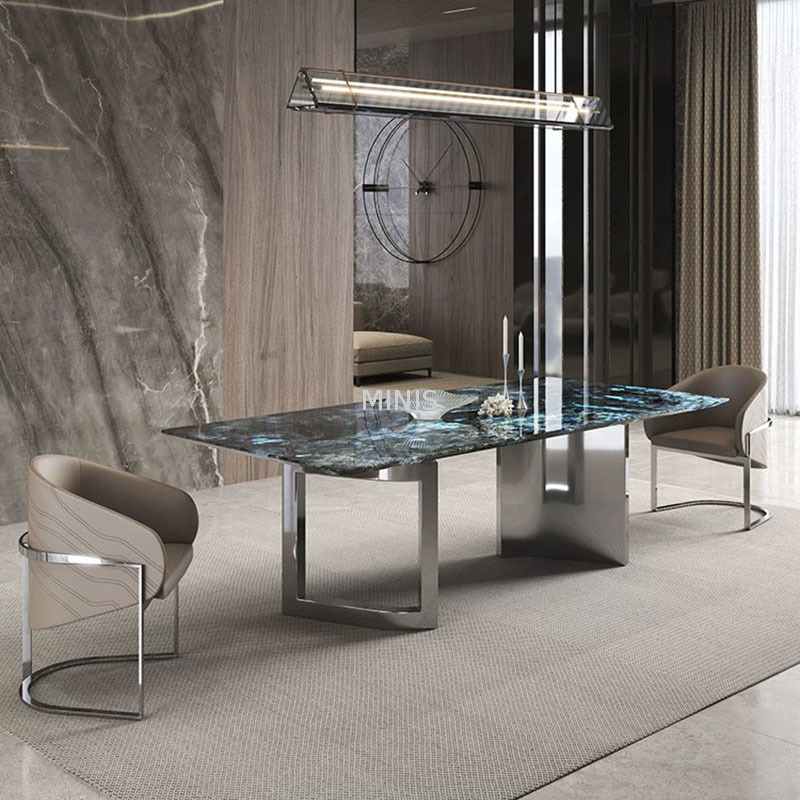
Evaluating marble furniture requires looking beyond the showroom floor. You must consider how a dining table performs during chaotic family dinners and holiday gatherings.
Hardness determines how well a surface resists scratches. Industry experts measure this using the Mohs hardness scale. Sintered stone scores an impressive 6-7 on the Mohs scale. It readily resists sharp knives directly on its surface. Conversely, natural marble scores only a 3-4. It will scratch easily if you drag ceramic plates across it.
Heat resistance is another crucial daily factor. Both natural stone and sintered stone handle hot pots beautifully. You can place hot cookware down without panic. Resin-based faux marble, however, strictly requires trivets to prevent permanent heat damage.
Stain resistance dictates your cleaning routine. Natural marble features a 1-3% water absorption rate. This porosity requires you to apply a chemical sealer every 6-12 months. High-end faux and sintered materials boast an absorption rate of less than 0.05%. They are virtually impervious to red wine, coffee, and oil.
Daily cleaning also differs dramatically. Natural stone mandates pH-neutral cleaners exclusively. Acidic sprays will instantly ruin the polished finish. Faux and engineered options readily tolerate standard household cleaners. You can sanitize them quickly without worrying about chemical damage.
Natural slabs typically range between 18-25mm thick. This incredible density requires heavy-duty reinforced bases. The sheer weight complicates moving or rearranging your room. Engineered stones can be manufactured much thinner. High-quality sintered slabs often measure just 12mm thick. They maintain excellent structural integrity while vastly reducing shipping complications and heavy floor loads.
Feature | Natural Marble | Resin-Based Faux | Sintered Stone |
|---|---|---|---|
Mohs Hardness | 3 - 4 (Prone to scratches) | 2 - 3 (Very soft) | 6 - 7 (Highly scratch-resistant) |
Porosity | 1% - 3% (Requires regular sealing) | Non-porous | < 0.05% (Virtually waterproof) |
Heat Resistance | High (Trivets recommended) | Low (Will melt or scorch) | Extreme (Fired at 1200°C) |
Cleaning Needs | Strictly pH-neutral cleaners | Standard mild cleaners | Any household cleaner |
You must ensure you receive what you pay for. Unscrupulous sellers sometimes charge premium natural stone prices for engineered materials. Knowing how to distinguish genuine stone from replicas protects your investment. Follow these specific steps to authenticate your chosen piece.
Check Visual Cues: Authentic stone features subtle, complex patterns. Look closely for overly vibrant, unnatural colors. Deep turquoise or bright orange usually indicates a manufactured product. Also, check multiple tables in a showroom. If you spot repeating grain patterns, the material is definitely engineered.
Perform the Temperature Test: Real marble possesses high thermal conductivity. It rapidly draws heat away from your skin. Rest your hand on the surface. Genuine stone feels noticeably colder to the touch than resin or acrylic-based faux tables.
Examine for Scratches: Natural stone often shows minor micro-abrasions from the fabrication process. Synthetic resin usually appears flawlessly uniform on top.
Inspect the Underside: Run your hand underneath the tabletop. The unpolished underside of genuine stone feels rough and raw. If it looks like a perfectly clean, manufactured mesh or a flat resin sheet, it is entirely engineered.
Choosing the right material only solves half the puzzle. You must correctly size the piece to fit your home. Proper spatial planning ensures your room remains comfortable and functional.
Room flow dictates your comfort level during meals. Regardless of the material you choose, you must ensure adequate walking space. Always leave a minimum clearance of 36 inches (approximately 90cm) between the table edge and your walls. You must also apply this rule regarding other dining room furniture. This vital space allows guests to pull out chairs easily and enables smooth walkway flow.
Your room's architecture should heavily influence your shape selection.
Rectangular Dining Table: A rectangular dining table remains ideal for formal, narrow spaces. It excellently maximizes seating capacity. For example, a standard 72"x36" size comfortably seats 6 to 8 adults.
Round Tables: Circular designs work much better for square rooms. They utilize smaller footprints effectively. They also serve homes with young children perfectly, as they eliminate dangerous sharp edges.
Stone surfaces inherently carry significant visual weight. You need to balance this heaviness with thoughtful chair selections. Try pairing your piece with contrasting materials. Velvet upholstery creates an immediate luxury feel. Alternatively, minimalist metal or warm wood frames deliver a striking mid-century modern look. These contrasts prevent the room from feeling overwhelmingly cold or sterile.
Your daily routine should ultimately dictate your purchase. An expensive material becomes a burden if it constantly causes you stress. Use this framework to match your lifestyle to the correct surface type.
Choose Natural Marble If:
You are furnishing a formal, low-traffic dining room reserved for special occasions.
You deeply value organic, one-of-a-kind aesthetics over pure, carefree functionality.
You are entirely willing to commit to strict coaster rules for all guests.
You promise to execute immediate spill cleanups, especially with wine and citrus.
You do not mind applying a chemical sealant bi-annually.
Choose High-End Faux / Sintered Stone If:
You need a rugged, everyday kitchen table that withstands heavy family use.
You frequently entertain large groups or have young, messy children.
You require zero stress over accidental spills, dropped forks, or heat damage.
You strongly desire the luxury aesthetic but prefer a simple "wipe-and-go" maintenance reality.
The choice between natural and engineered materials is rarely just about budget. It is ultimately a choice between organic exclusivity and modern practicality. Natural stone delivers unparalleled, timeless beauty but demands ongoing vigilance and care. High-end faux and sintered stones offer near-indestructible performance while successfully capturing that coveted luxury aesthetic.
Before you finalize your purchase, take immediate action. Measure your dedicated dining space carefully to guarantee that crucial 36-inch clearance. If you lean toward natural stone, verify your floor's weight capacity first. Finally, always request a physical material sample. Test this sample against your everyday dishware at home to ensure it meets your daily functional needs.
A: No, they are fundamentally different. Sintered stone is an ultra-compact natural mineral surface fired under extreme heat. It features incredible hardness and heat resistance. Traditional faux marble often relies on softer plastics, resins, or wood laminates, which easily scratch and melt.
A: Resin-based faux marble can indeed yellow with heavy UV exposure over the years. However, high-quality sintered stone and ceramic options are entirely UV-proof. They will retain their bright, crisp color for decades, even in sunny rooms.
A: While natural marble is generally heat-resistant, sudden extreme temperature changes remain risky. This rapid change can cause "thermal shock," which may lead to deep cracking. You should always use a trivet to protect both the chemical sealant and the stone itself.


